 how-to
How to Start Bible Study as a Beginner Woman
Last Updated: October 30, 2026
Quick Summary
Bible study beginners can start with one short passage, read it slowly, and ask one honest question, spending about ten to fifteen minutes a few days a week. You need only a main Bible, a simple notebook, a pen, and a bookmark. Stick with one method, such as observe, interpret, apply, and build from there.
- Pick one short passage and read it slowly instead of covering a lot of text.
- A readable translation such as the NIV or NLT suits most beginners for long stretches.
- Start with four tools: one main Bible, a notebook, a pen you like, and a bookmark.
- Aim for ten to fifteen minutes, three or four days a week, using a time you already have.
- If you miss days, skip them and keep going rather than starting over or quitting.
Table of Contents
- Why Bible Study Feels Hard to Start (and Why That's Normal)
- Choosing a Bible Translation and Study Tools Without Overwhelm
- A Realistic Bible Study Plan for Beginners
- Easy Bible Study Methods You Can Use Today
- Bible Study Questions for Beginners to Ask Every Passage
- Short Bible Studies for Women With Busy Schedules
- Your First Week of Bible Study, Step by Step
- Frequently Asked Questions
Why Bible Study Feels Hard to Start (and Why That's Normal)
Starting Bible study can feel harder than it should. If you're feeling discouraged, how to meet God in the middle of a busy day offers a practical approach for a distracted schedule.
A busy schedule, a long book with unfamiliar names, and a sense that you must "get it right" all add friction.
Here is what usually goes wrong:
- You try to read too much at once
- You feel you need commentary before you can understand anything
- You measure progress by how much you covered, not by what you noticed
The fix is smaller, not bigger. Pick one short passage, read it slowly, and ask one honest question. That alone counts as Bible study for bible study beginners.
Choosing a Bible Translation and Study Tools Without Overwhelm
You do not need a shelf of resources to begin. If you're weighing options, compare the best Bible study books for women for beginners and small groups. Choosing a translation is the first decision, and it matters less than most guides suggest, but it does help to know what you are choosing between.
The Three Translation Approaches You Will See
Most English Bibles fall into one of three approaches. Knowing the difference keeps you from second-guessing your pick.
- Word-for-word (formal equivalence). These follow the original grammar closely. The King James Version (KJV) and New American Standard Bible (NASB) are common examples. They are precise but can read stiffly for a beginner.
- Thought-for-thought (dynamic equivalence). These translate the meaning of phrases rather than each word. The New International Version (NIV) and New Living Translation (NLT) are common examples. Most beginners find these easiest to read for long stretches.
- Balanced (optimal equivalence). These sit between the two. The Christian Standard Bible (CSB) and English Standard Version (ESV) are common examples. They keep more of the original structure while staying readable.
A practical starting point: pick the NIV or NLT if you want smooth reading, the ESV or CSB if you want a balance, and the KJV only if you are already comfortable with older English. You can always compare a second translation later, most study apps let you switch versions in one tap.
The Only Four Tools a Beginner Needs
You do not need a study Bible, a commentary set, and a workbook on day one. Start with these four, and add nothing else until you have used them for a month.
- One main Bible. Choose a version with clear section headings and a readable font (10-11 point is common for print). Use it consistently so you learn its layout.
- A notebook or journal. A simple lined notebook works. Write the date, the passage, one observation, and one question. Brief notes are easier to return to than long essays.
- A pen you like. This sounds trivial, but a pen that writes smoothly removes friction from the habit.
- A bookmark or ribbon. You will lose your place otherwise, and losing your place is one of the quiet reasons people stop.
When to Add a Study Bible or Workbook
They are helpful once you have read a passage yourself and still have questions. The risk for beginners is reading the notes instead of the Bible, a common pattern is to spend ten minutes on commentary and two on the text.
Guided workbooks and video studies can provide structure or group support. They are optional, and they are not a prerequisite for understanding Scripture.
A Realistic Bible Study Plan for Beginners
A good beginner plan fits into the day you actually have. For a full routine from the start, see a beginner's guide to Bible study at home with practical steps and methods. Think ten to fifteen minutes, three or four days a week, to start.
Try this simple rhythm:
- Pick a time you already have. Many women use the minutes after breakfast or during a lunch break.
- Choose one short passage. Start with a single chapter or a few verses.
- Read it twice. The second read is often where things click.
- Write one observation and one question.
- Close with a short prayer.
Build from there. After a few weeks, add a second day or lengthen your reading slightly. Consistency matters more than speed.
Easy Bible Study Methods You Can Use Today
Simple methods help you stay focused. You do not need to memorize a system. Choose one and practice it for a week.
The Observe, Interpret, Apply Method
This three-step method works well for almost any passage:
- Observe: What does the text say? Note key words, people, and actions.
- Interpret: What did this mean to the first readers? Ask what the writer wanted them to understand.
- Apply: How does this change how I think, speak, or act today?
Keep each step short. A few sentences per step is enough.
Reading a Passage Without Prior Knowledge
You do not need background knowledge to read well. Start with the text itself.
Look for:
Join our Listener Circle for gentle encouragement →
- Who is speaking, and to whom
- What problem or situation is described
- Any repeated words or phrases
A common mistake is skipping the context around a passage. Read a few verses before and after your section so you know where it fits.
Bible Study Questions for Beginners to Ask Every Passage
Good questions open the text. Use these every time you study, and add your own as you grow.
- What does this passage tell me about God?
- What does it tell me about people?
- Is there a command, promise, or warning?
Write your answers in a few words. Brief notes are easier to return to than long essays.
Short Bible Studies for Women With Busy Schedules
If your days are packed, short studies are a good place to begin. To see how study guides differ from devotionals in time commitment and depth, read Bible study guide vs devotional for busy women. You can also browse short Bible study plans for busy moms that fit a crowded day.
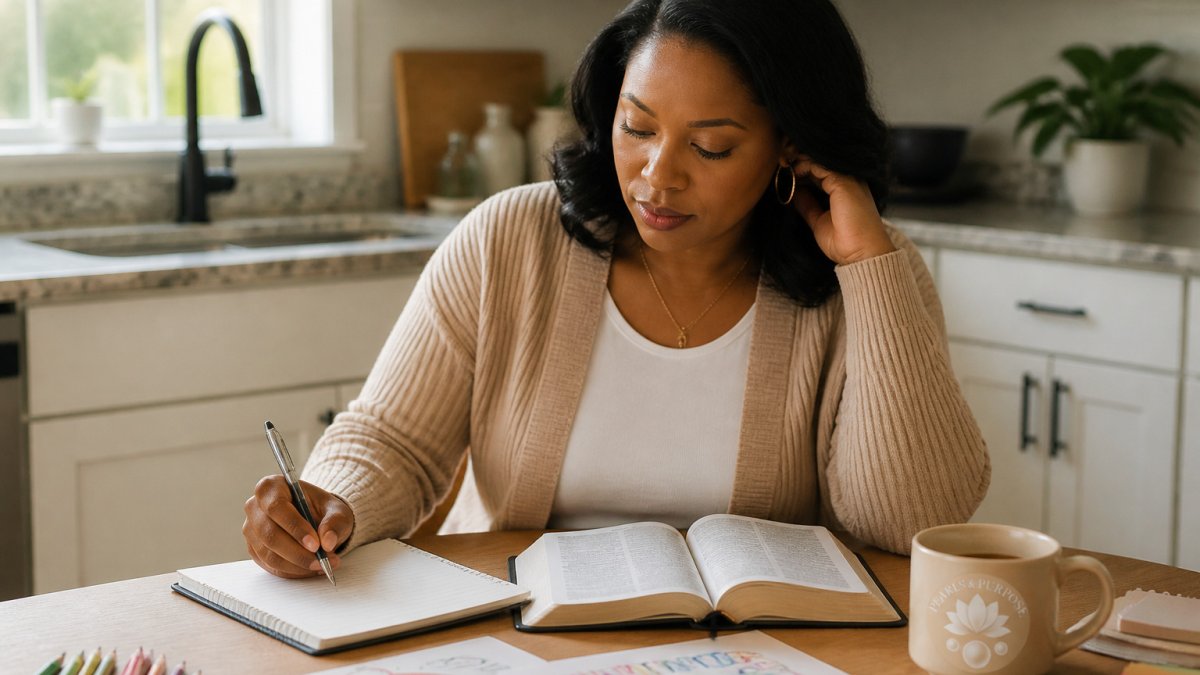
Try these quick formats:
- Five-verse study: Read five verses, ask one question, write one takeaway.
- Single-idea study: Pick one word, such as "peace" or "rest," and find where it appears.
- Morning or bedtime reading: Read one short psalm or proverb.
Short studies build the habit. Over time, you may find yourself wanting more depth, and that is a good sign.
Your First Week of Bible Study, Step by Step
Here is a simple plan you can follow starting today. Each session is designed for 10-15 minutes, and each day builds on the last. If you miss a day, do not restart, pick up where you left off. The plan is a rhythm, not a test.
Before Day 1: Pick Your Starting Book
Choose one book to begin. Two commonly suggested options:
- The Gospel of John. A narrative account of Jesus's life with clear stories and repeated themes (light, belief, love). About 21 chapters, roughly three weeks at one chapter a day.
- Psalms. A collection of 150 prayers and songs covering fear, gratitude, anger, and praise. Start with Psalms 1-10 and read one per session.
Either can work. The point is to stay in one book long enough to notice its patterns.
The Seven-Day Plan
- Day 1, Choose and read. Pick your translation and book. Read one chapter slowly, out loud if you can. Do not stop to look anything up. Just read.
- Day 2, Observe. Reread the same chapter with a pen. Underline repeated words, circle names, and mark anything that surprises you. Write one sentence: "This chapter is mostly about ____."
- Day 3, Interpret. Read the chapter again and ask: Who is speaking? Who is listening? What problem or situation is described? Write two or three sentences answering those questions.
A Worked Example: John 3:1-21
To show what this looks like in practice, here is a short example using a well-known passage.
Observe. A man named Nicodemus comes to Jesus at night. He is a Pharisee, a religious leader.
Interpret. Nicodemus arrives with status and knowledge, yet he leaves with questions.
Apply. One action: this week, when I feel I should already understand something, I will ask a question instead of pretending.
If You Miss a Day (or Three)
Most beginners miss days. A common pattern is to miss two or three, feel behind, and quit. Do not let a missed day become a missed month.
- Missed one day? Skip it. Move to the next day in the sequence.
- Missed three or more? Restart at Day 1 with the same chapter. Rereading is not wasted time.
- Missed a week? Start a fresh seven-day cycle with a new short passage. The habit matters more than the streak.
At the end of the week, notice what felt manageable. Adjust the plan to fit your life, not the other way around.
Here is a quick overview of the seven-day plan so you can see the rhythm at a glance.
| Day | Focus | Action |
|---|---|---|
| Day 1 | Choose and read | Read one chapter slowly, no lookups |
| Day 2 | Observe | Underline repeated words and mark surprises |
| Day 3 | Interpret | Answer who is speaking and what the problem is |
| Day 4 | Rest or reread | Skip study or reread Day 1 |
| Day 5 | Apply | Write one specific action for this week |
| Day 6 | Share | Tell one trusted person one thought |
| Day 7 | Review | Read your notes and pick next week's passage |
Frequently Asked Questions
How should a beginner start studying the Bible?
Start small and consistent. Pick one book, such as the Gospel of John or Proverbs, and read one short passage a day. Use a simple translation like the NIV or ESV, and write down what the passage says, what it might mean, and one way to apply it. Most beginners do better with 10 to 15 focused minutes than with long, irregular sessions. Once the habit holds for a few weeks, you can add a question prompt or a short study guide to deepen your reading.
What is the easiest book of the Bible to study for beginners?
Many beginners start with the Gospel of John because its stories are clear and its teachings about Jesus are direct. Proverbs is another good choice because each chapter is short and self-contained, which suits daily reading. Psalms also works well for women who want to read a short passage and reflect on it. Choose the book that matches what you need most right now, whether that is comfort, practical wisdom, or a clear picture of who Jesus is.
What do you need for a simple Bible study?
You need a Bible, a notebook or journal, and a quiet place for about 10 to 15 minutes. A free app or online Bible can replace a printed copy if that is easier. Study guides and video teaching are optional. Many women find a basic set of three questions enough: What does this passage say? What does it mean? How does it apply to my life today? A pen and paper make it easier to slow down and record what stands out.
How can women make time for Bible study with a busy schedule?
Attach Bible study to a routine you already have, such as while the coffee brews, during a lunch break, or after children are in bed. Keep the first sessions short, around 10 minutes, so the habit is easy to keep. If mornings are chaotic, try a short reading in the car before work or a few verses during a school pickup. Consistency matters more than length, and a short study you actually finish is better than a long plan you abandon.